

When Everything Is New, Nothing Is Deep
Philip Glass, repetition, and the overlooked discipline of duration in culture and life.

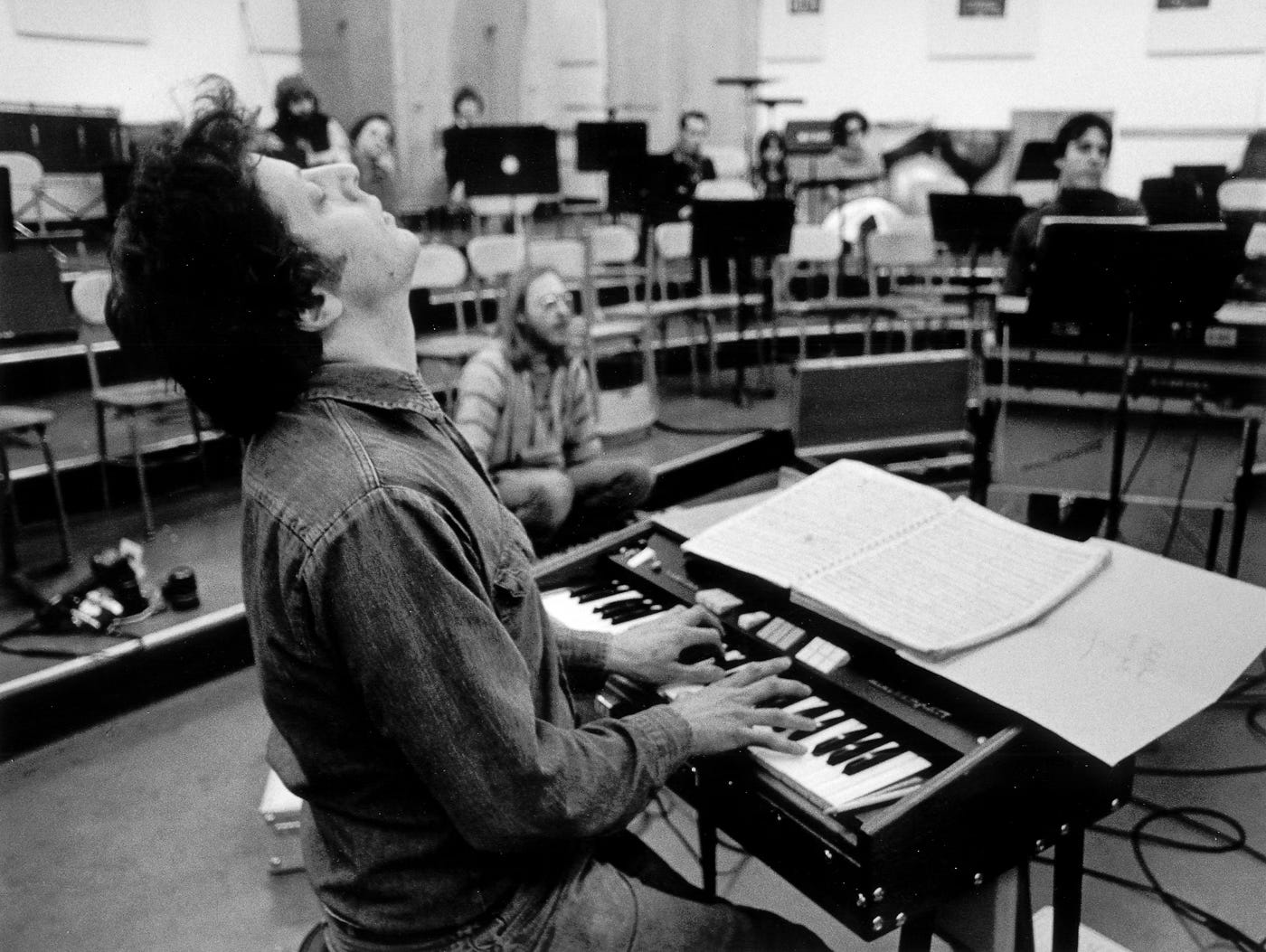
MEDIA ROOM is our series collecting the films, albums, and songs for the moment at hand—selections for the perfect evening tuned to set the vibe.
Philip Glass has long resisted the reductive label minimalist. He prefers “music with repetitive structures,” a formulation that reframes not the quantity of repetition but the condition it creates. In his own words, “I’ve been called a minimalist composer for more than 30 years, and while I’ve never really agreed with the description, I’ve gotten used to it.”
This resistance indicates a deeper philosophical stance: repetition, for Glass, is not a stylistic restraint but a form of cognitive habitation. Repetition is an invitation to listen differently, to surrender preconception and observe the subtle internal shifts that emerge only when the surface appears fixed. On a basic level, this echoes his practice: “If you don’t have a basis on which to make the choice, then you don’t have a style at all. You have a series of accidents.”
The composer’s relationship to repetition is not static; it is processual and dynamic. Repetitive structures are not loops in the caricatured sense but frameworks within which micro-variation unfolds. As one musicological analysis puts it, Glass’s additive techniques—where elements are subtly augmented or diminished—create a discourse that both holds and transforms.
This insight, when transposed to culture and design, reveals a challenge to the prevailing fetish for novelty. Contemporary environments—be they hospitality spaces, urban districts, or corporate brands—are often constructed for immediacy: the visual impact that yields quick attention and quick obsolescence. But what Glass’s practice foregrounds is the temporal architecture of attention, the way perception deepens when it is not being coaxed forward but kept present. Spaces are not merely seen; they are inhabited through duration. Objects are not simply consumed; they are experienced through return and reuse.
Glass himself hinted at the transformative potential of repetition beyond music: “What came to me as a revelation was the use of rhythm in developing an overall structure in music.” Here rhythm is not decoration but the engine of comprehension. Rhythm unfolds time, and time is the medium in which subtle change becomes legible.
This principle has philosophical corollaries beyond art. A routine recognized as constraining on the surface, when held with commitment, becomes a locus for deepening perception. A material palette deployed with consistency becomes legible because its stability allows nuance to emerge. A city visited repeatedly reveals layers that escape a touristic, novelty-driven itinerary.
Such a stance complicates the contemporary valorisation of acceleration. Instead of equating change with progress, one might consider duration as a proposition: to dwell, to abide, to attend — and to allow complexity to emerge not from addition, but from cumulative attentiveness.
Glass’s music asks the listener not to wait for something to happen but to become different by staying with what is already present. In such a formulation, repetition is not an aesthetic motif; it is a profound epistemological tool.
A Playlist to Engage Inner Change
The following pieces exemplify how Glass’s repetitive structures operate not as loops but as evolving fields of attention. Listen for the micro changes that reveal perception itself.
1. Music in Twelve Parts – An extended work in which repetition and incremental variation define the architecture of time itself. Early impatience gives way to a heightened sensitivity to rhythm, alignment, and minute variation. The work teaches endurance without rewarding it.
In life, this mirrors what happens when we remain with a practice, a place, or a relationship beyond its initial legibility. Only once novelty has been exhausted does perception become precise.
2. Einstein on the Beach (Knee Play 2) – A seminal section from the genre-defying opera where thematic continuity and structural recurrence foreground how listening itself transforms.
The work refuses to help the listener “move through” it. Instead, it asks the listener to remain inside it long enough for expectation to collapse. Once expectation dissolves, attention redistributes. The opera becomes a study in how meaning forms when we are no longer being guided forward — a lesson increasingly absent from contemporary culture.
3. Glassworks: Opening – A work in which the cumulative effect of iterative motifs reveals the underlying geometry of attention. Applied beyond music, Opening models a form of engagement increasingly at odds with novelty culture: refusing to accelerate, paired with a trust that attention, once settled, will begin to notice what speed obscures.
4. Satyagraha (Act I) – Repetition as insistence and as a structural device in the opera inspired by Gandhi’s philosophy of truth-force.
5. The Hours (Morning Passages) – Micro-variation in a film score that parallels narrative temporality, showing how recurring material shapes emotional architecture.
What these works reveal is that depth is not produced by complexity or novelty, but by duration under stable conditions. The music remains, yet the listener becomes different.
That, ultimately, is the proposition.
If you listen, I hope you stay longer than feels necessary. That’s where things start to open.